
Chevron: Best Positioned Player in the Venezuelan Energy Market

News of the capture of Nicolás Maduro, now former president of Venezuela, might lead some market participants to expect an immediate impact on energy markets. This assumption is understandable, given that the Caribbean nation sits atop the world’s largest proven oil reserves, estimated at 303 billion barrels—approximately 17% of global reserves—according to data from the U.S. Energy Information Administration (EIA).
However, this morning crude oil futures continue to trade lower, down 0.76% at USD 56.88 per barrel, a level that remains persistently subdued.
The underlying reasons were outlined in a previous note published several weeks ago and relate primarily to a global oversupply environment, despite ongoing geopolitical tensions. Global oil demand currently stands at approximately 105 million barrels per day, while production is closer to 108 million barrels per day. Moreover, Venezuelan oil production and exports are, in practice, relatively low and largely marginal to the global balance: current output is around 950,000 barrels per day, with approximately 550,000 barrels exported. Export activity has faced additional constraints in recent months due to new sanctions targeting the so-called “shadow fleet” used to transport part of this supply.
Venezuela’s oil industry was nationalized in the 1970s, leading to the creation of PDVSA (Petróleos de Venezuela, S.A.). Since then, decades of underinvestment—compounded by structural inefficiencies and a strained relationship with its northern neighbor, the United States—have left infrastructure outdated and production sharply reduced. Output has fallen by nearly 70% from its late-1990s peak of approximately 3.5 million barrels per day. PDVSA is also heavily indebted, and this debt burden ultimately contributed to Venezuela’s sovereign default in 2017.
Only a limited number of foreign companies remain meaningfully positioned in the country. Chevron is the most significant, although Repsol and Eni also maintain investments and strategic interests. Nevertheless, any meaningful modernization of production systems—and a potential return to output levels seen at the end of the last millennium—would require several years at a minimum.
TECHNICAL ANALYSIS
Chevron (CVX) closed last Friday’s trading session up 2.29% at $155.90. Since late 2021, the stock has consistently held above the $132 level (for reference, it traded as low as $40.50 in April 2020). Price action since then has been largely sideways, contained within a very wide trading range that has frequently extended above the $170 area. This implies a range of more than $40, equivalent to roughly 25% of the current share price.
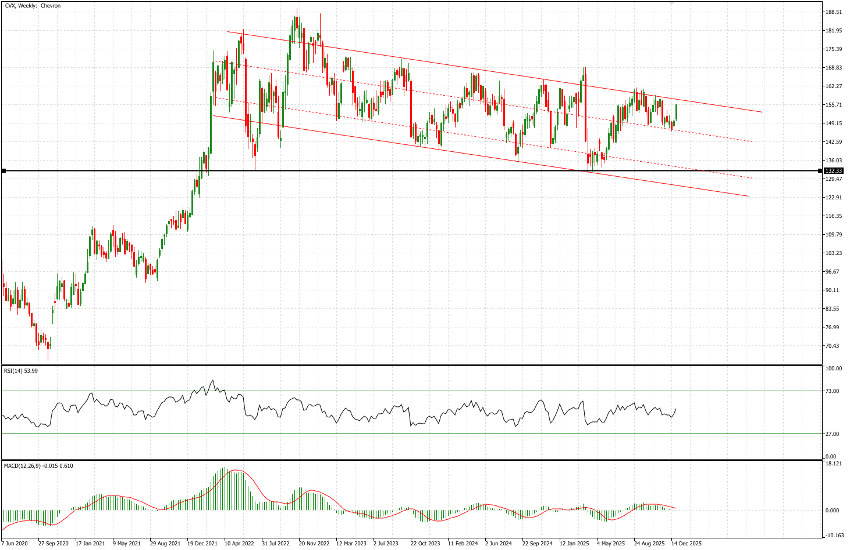
The recent high was recorded in early September at $161.67. From that level, the stock entered a corrective phase, reaching a low of $146.35 on December 15. Since then—partly supported by seasonally low trading volumes during the holiday period—the shares have rallied by approximately 6.42%.
Looking ahead, we identify $156.15 as the first key resistance level and an important test for the continuation of the current upward move. Beyond that, $157.75 and $161.15 represent further significant levels that would need to be tested and decisively broken to confirm additional upside. Technical indicators are supportive: the 21-day RSI stands at 63.79, and the MACD histogram has just turned positive.
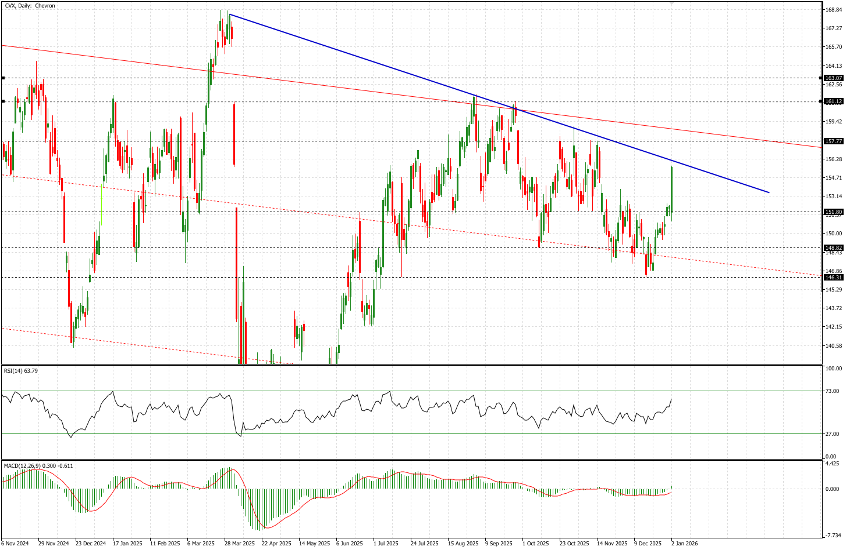
On the downside, initial support is seen at $151.80, followed by $148.82. We believe the stock still has room to appreciate despite the currently depressed oil price environment. That said, we would emphasize that—even though Chevron is the best-positioned multinational in Venezuela at present (exporting approximately 150,000 of the country’s 550,000 barrels per day)—any potential benefits stemming from the new and so far complex political situation are likely to materialize over the long term rather than in the near term.