
USDZAR at 15.90 as Rand Gains 11%

South Africa enters 2026 on a cautiously constructive trajectory. Headline inflation moderated to 3.6% in December, enabling the South African Reserve Bank (SARB) to maintain its policy rate at 6.75% at its late-January meeting. This calibrated stance underscores rising institutional credibility around the SARB’s revised 3% inflation target, lowered from the previous 4.5% midpoint, and signals a firm anchoring of medium-term inflation expectations.
While real GDP growth remained subdued at approximately 1.3–1.4% in 2025, forward-looking indicators point to a gradual acceleration toward 1.8–2.0% over the medium term. This outlook is supported by the continued implementation of structural reforms under Operation Vulindlela, alongside a cyclical recovery in commodity-linked sectors, which remain integral to South Africa’s external earnings profile.
Fiscal dynamics have improved materially. The government has recorded primary surpluses for two consecutive fiscal years and projects an expansion from roughly 0.9% of GDP currently to 2.5% by FY2028/29. Enhanced revenue collection, particularly from elevated precious metals prices, has reinforced fiscal consolidation efforts. This improving sovereign credit narrative was validated by S&P’s rating upgrade in late 2025, reflecting strengthened debt sustainability metrics and improved policy credibility.
The rand’s recent appreciation—trading near 15.9 against the U.S. dollar, its strongest level since late January—has been driven primarily by robust commodity prices and broad-based dollar softness. Gold, platinum, and palladium collectively account for approximately 20% of total exports, generating substantial foreign exchange inflows and structural demand for ZAR-denominated revenues. Beyond cyclical tailwinds, however, the currency’s resilience also reflects strengthening domestic fundamentals: a credible and disciplined monetary framework, political stability under a functioning coalition government, and tangible progress in addressing longstanding bottlenecks in energy and logistics infrastructure.
Moreover, South Africa’s transition to a primary surplus and its removal from the FATF “grey list” have meaningfully compressed sovereign risk premia. This repricing has shifted investor perception of the rand from a structurally underperforming currency to one of the stronger performers within the emerging market FX complex in 2026.
Finally, the positive interest rate differential continues to support the rand through carry trade dynamics. South Africa’s relatively elevated real yields remain attractive in a global context, incentivizing portfolio inflows into ZAR-denominated assets and reinforcing the currency’s external position.
TECHNICAL ANALYSIS
The longer-term chart clearly highlights the pronounced downtrend that began on 8 April 2025, from levels just below 20.00. The 17.12 area has acted as a significant floor since at least 2022 and is therefore marked as a key resistance level (in bold black). Additional historical levels derived from late 2021–2022—when USD/ZAR was trading around current levels—include 16.80 and 16.39, although these are not fully visible on the shorter time horizon displayed.
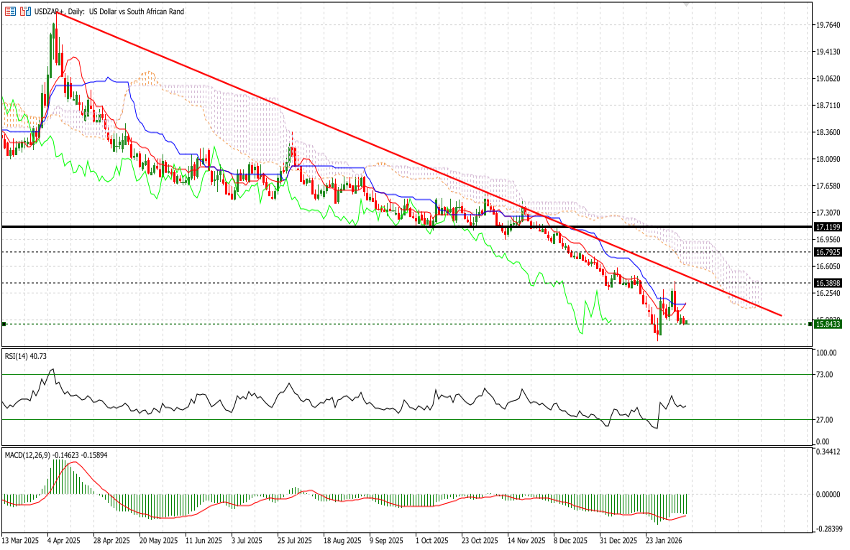
A tentative low was established at 15.62 on 29 January. From that point, a rebound carried the pair toward the first resistance at 16.39, which capped the recovery and pushed prices back toward the current 15.84 area.
Momentum indicators are beginning to show early signs of potential stabilization. The RSI suggests the emergence of a mild bullish divergence. The MACD remains in negative territory; however, the histogram has been trading above the signal line for several sessions, indicating waning bearish momentum. Meanwhile, the Ichimoku setup shows the fast conversion line (Tenkan-sen) attempting a bullish crossover of the slower base line (Kijun-sen), a development that could reinforce short-term upside attempts.
At this stage, price action may be entering the initial phase of a stabilization process, with a near-term trading range likely between 15.71 and 16.40. The descending trendline—currently intersecting near 16.48—will be a critical test to determine whether the broader downtrend is losing momentum.
From a macro perspective, fundamentals continue to favor the rand over the medium term. Should bearish pressure resume, a break below 15.62 would open the way toward 15.40 initially, followed by 15.17. Nevertheless, we believe that a corrective rebound attempt may begin to take shape in the coming weeks on this cross.
