
GBPUSD: Weak Growth, Stubborn Inflation and Budget Concerns

At 08:00 GMT this morning, the minutes of the latest meeting of the Financial Policy Committee (FPC) will be released. The FPC is the Bank of England’s body responsible for safeguarding the stability of the UK financial system. Its assessment will be particularly interesting given that the country’s macroeconomic backdrop is far from vibrant—although, to be fair, the UK is not alone among its peers. Growth is weak and decelerating, with GDP up just +0.1% in Q3 2025 after +0.3% in Q2. Consumer momentum is soft, as shown by Retail Sales at –1.1% MoM in October, and still firmly below pre-pandemic levels.
On the fiscal side, the budget deficit remains elevated (the latest official reading stands at 4.8%), and a return to the 2% deficit target is expected only further out, likely around 2029/2030. High deficit and debt levels (debt at 106% of GDP), combined with the “back-loaded” structure of the announced tax increases—meaning most of the consolidation comes in later years—continue to raise concerns over long-term fiscal credibility. Inflation, although sharply lower than its peak of 11.1% a few years ago, remains at 3.6%, well above the 2% target. The target is now projected to be reached only by Q2 2027 (whereas just a couple of years ago expectations pointed toward 2025).
The Bank of England must therefore navigate a fragile equilibrium: an economy that is not buoyant, yet the need to maintain monetary and financial stability and avoid reigniting inflation argues against premature easing. This likely explains why Bank Rate was held at 4% again in November. Let’s look at the GBPUSD setup.
Technical Analysis
Price action in 2025 has been essentially split into two phases. Until early July, GBPUSD strengthened steadily, reaching a high of 1.3789 on July 1st after rallying from the year-to-date low of 1.2100 on January 13th. The move was likely supported by expectations of a narrowing US-UK rate differential, with markets anticipating more aggressive Fed cuts compared to the BoE.
In the second half of the year, however, the pair lost momentum—first stabilizing in the 1.34–1.366 area through early autumn, and then drifting lower to yesterday’s settlement at 1.3209. This level already reflects a rebound from the recent low of 1.3010 reached on November 4th.
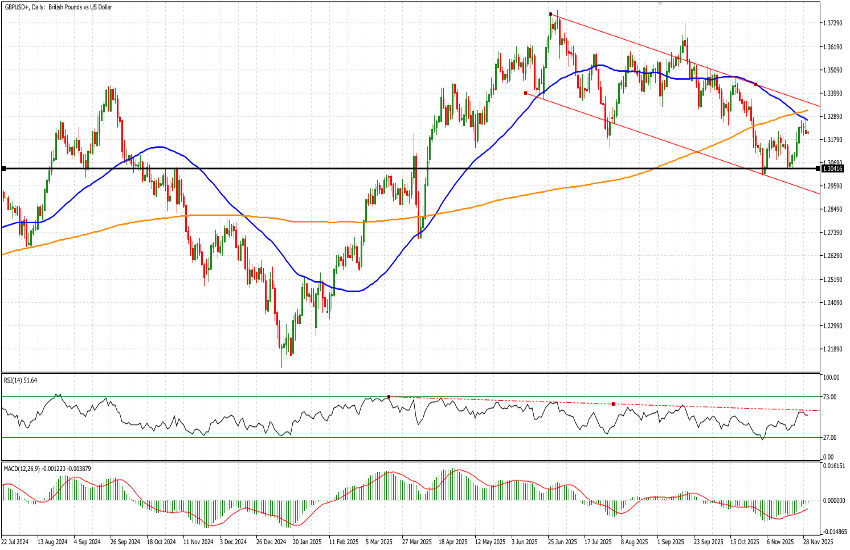
One technical feature stands out: the bearish crossover between the 200-day and 50-day moving averages—known to technical analysts as a death cross, and considered one of the more reliable bearish signals. This occurred on November 25th around 1.33. Yesterday, GBPUSD printed an inverted hammer (albeit with a relatively short upper shadow) after testing the negatively sloped 50-day moving average at 1.3276.
If we also consider that the last five months of price action can be framed within a mildly descending channel—with the upper band sitting near 1.3350 today—there appears to be room for further downside in Cable. Potential targets include 1.3185, 1.3145, 1.3090 and the key 1.3050 area. A break below this latter level could open the way toward retesting the November lows around 1.30 and potentially the lower boundary of the channel near 1.2940.
On the upside, risk levels are defined by the two moving averages (1.3275 and 1.3315), followed by the upper channel line at 1.3350. It will be interesting to see whether the death cross maintains its strong historical record as a reliable predictor of further bearish continuation.
