
Walmart Remains Firm Near the $1 Trillion Mark

The first major macroeconomic data point of the week is just around the corner: U.S. Retail Sales. The American consumer alone accounts for roughly 70% of U.S. GDP, while the retail sector represents 6.2% of GDP and is the largest private employer in the country. These figures alone explain why this release consistently attracts close market attention.
Annual growth in Retail Sales has slowed somewhat since early 2025, after repeatedly reaching levels near 5%, but it remains relatively solid at +3.3% year-on-year. On a monthly basis, the figure is expected to ease slightly to +0.4%, compared with +0.6% previously.
Recently, there has been increasing discussion about so-called “20th-century dinosaurs” outperforming the super-tech companies of the 2000s—at least in equity market terms—and Walmart is a prime example. On February 3, 2025, the largest U.S. retailer by revenue officially joined the $1 trillion market capitalization club, where it has remained firmly ever since. While its earnings will be released on February 19, the company now ranks as the 10th largest U.S. firm by market capitalization.
This re-rating is largely driven by a strategic shift toward the adoption of intelligent technology systems and a transition from simply selling products to owning the platforms through which those products move. Under new CEO John Furner, Walmart is deploying “AI Super Agents” across its supply chain to forecast demand, automate inventory management, and even negotiate with suppliers. By the end of 2026, the company expects 65% of its stores to be serviced by automated supply-chain fulfillment centers.
Walmart’s advertising business is also booming, with revenues up 53%. This segment represents a high-margin growth engine, delivering operating margins in the 60%–80% range. In a subtle but meaningful move, Walmart transferred its stock listing to the Nasdaq in late 2024, reinforcing its positioning as a technology-first company.
From a revenue standpoint, Walmart reported $179.5 billion for the quarter (approximately +6% year-on-year), putting it on track to potentially exceed $700 billion in annual revenue. Global e-commerce sales surged 27%, further underscoring the strength of its digital strategy.
Technical Analysis
Walmart crossed the $1 trillion valuation threshold when the stock broke above $125.47. As of yesterday’s close, the shares are trading at $129.02, up 14.04% year-to-date.
The stock has been in a steady uptrend since May 2024, when it was trading around $60. The advance has been relatively orderly: the supporting trendline was tested in April and again in November 2025, confirming it as solid support. From there, we can draw an upper channel boundary, which appears to have been touched last Friday near $131.50. However, we remain cautious regarding this upper boundary due to limited confirmation.
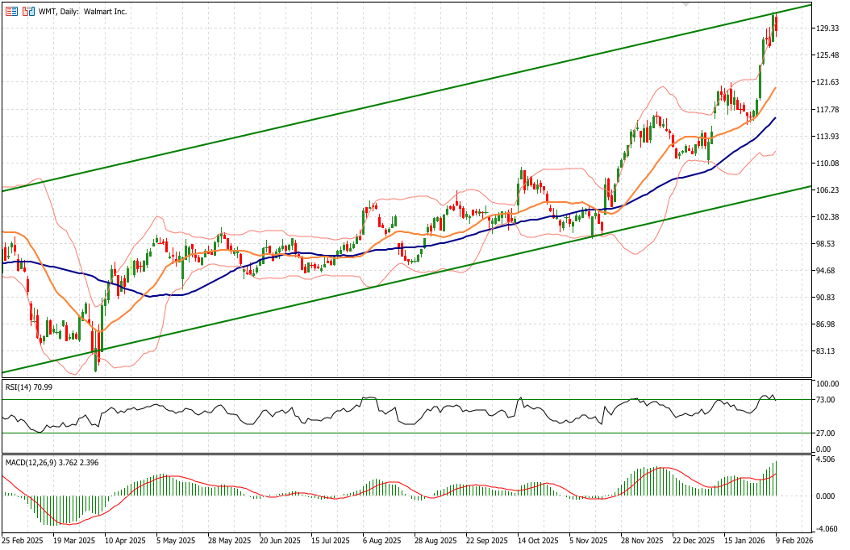
Bollinger Bands have widened, and the price has now closed above the upper band for four consecutive sessions, signaling strong momentum. The 21-day and 50-day moving averages are currently at $121 and $116.50, respectively—approximately 6.75% below current price levels.
We believe the stock can remain supported at these elevated levels at least until the official earnings release next Thursday. After that, some profit-taking would not be surprising given the magnitude of the rally. For now, we are closely monitoring short-term levels at $128, $129.40, and $131.60.
