
EURUSD, 2026 Runs Flat Compared to 2022

In the next 48 hours, all the major central banks in the world will meet and decide the next steps in their respective monetary policies, after the Australian RBA once again raised its benchmark rate on Tuesday morning. It starts in a few hours with the Bank of Canada, followed by the Fed, then BOJ, SNB, ECB, BOE, and finally the PBoC closing the cycle on Friday night.
No surprises are expected from the Fed today, no moves: rates will remain unchanged at 3.50% / 3.75% and will likely stay that way at least until September (expectations have shifted further into 2026 in recent weeks; previously markets expected a cut in June). The dot plot and new quarterly economic projections are also expected to remain largely unchanged, and the institution is also dealing with uncertainty around the incoming chairman Warsh, who is expected to take office in May but whose appointment is being delayed by a case U.S. Attorney Jeanine Pirro is pursuing against Powell.
Long-term inflation expectations rose significantly in March, with the 10-year breakeven moving from 2.25% to 2.38%, while the long end of the yield curve broke above 4% and reached 4.2826% before pulling back slightly. The cause is, of course, the surge in energy prices. Despite this, the labour market is not particularly strong, with job creation and real household disposable income stalling over the past six months. This marks a major difference from 2022, when the US consumer was still benefiting from strong post-Covid fiscal stimulus that sustained inflationary pressure. This time, a prolonged war scenario could even lead to demand destruction and therefore lower inflationary pressures over the long term, say into 2027. In any case, the consensus for the Fed remains for further rate cuts, at least one this year, although pushed further out in time.
The situation is different for the ECB, where the market has already started pricing in a rate hike by July or August, as reflected in 1-month ESTR futures. CPI month-on-month had already risen significantly in February (+0.7% versus -0.6% previously), and the continent’s much higher energy dependence, especially on gas, compared to the US risks driving a much stronger increase in prices. It is true that after the 2022 crisis, Europe significantly diversified its natural gas and LNG supply sources, despite the weight of imports from Qatar, and has also invested in the actual expansion of renewable energy. However, the still fragile growth, which could be further weakened by rising prices, may trigger internal debate within the ECB, making tomorrow’s meeting and press conference particularly interesting.
In any case, the reader will have noticed a certain divergence between the two central banks, and for this reason we lean toward an EURUSD exchange rate that, despite its current evident weakness, should not have much room to fall excessively before finding a floor for its next leg. Let’s see where.
TECHNICAL ANALYSIS
Today’s chart has a rather long-term perspective. We see EURUSD trapped between 1.1420 and 1.1775 for months, since last May. Only last Friday was the lower bound of this range tested, in oversold conditions. We are now witnessing a weakening of the USD. The 1.1420 level is clearly very important and we suspect it will be retested within the next few weeks at most. For bulls, it is crucial that this level holds, as a break would open the way for an extension toward the next truly significant level, around 1.1075. In between lie the barriers at 1.1280 and 1.12.
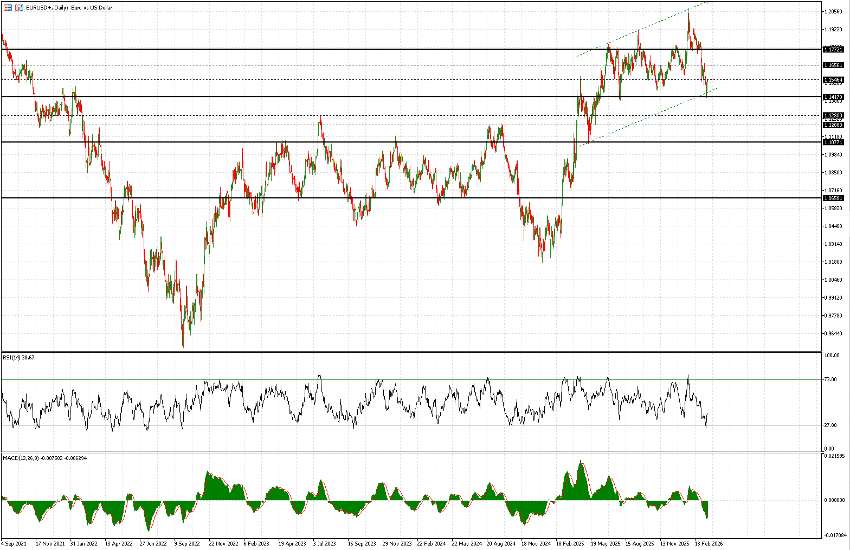
That said, it is difficult to see EURUSD falling below 1.10 this year (we are talking about a medium-term horizon of a few months here). The combination of stronger inflation and growth effects in the euro area in the short term should be offset by the divergence that seems to be forming between central banks. On the other hand, if the energy crisis were to persist, demand destruction in the US could also alter the outlook across the Atlantic. There is still room for the pair to move lower, but we do not see a situation similar to 2022, when it collapsed by 22% to below parity.
