
Big Tech Earnings Season Kicks Off

Meta Platforms, Microsoft, and Tesla reported earnings after the market close on January 28, 2026, covering Q4 2025 results for Meta and Tesla, and Q2 FY2026 results for Microsoft. Overall, the reports delivered a mixed set of beats, underscoring continued optimism around AI while exposing growing divergence in how effectively each company is deploying capital.
While headline results largely exceeded consensus expectations, market reactions varied sharply, driven less by earnings strength and more by perceived efficiency of capital allocation. As we move into 2026, the dominant theme is no longer simply AI potential, but AI profitability. Meta is funding its ambitions through a resurgent advertising engine, Microsoft is facing increased scrutiny over the scale and returns of its infrastructure investments, and Tesla is navigating a challenging transition from an automotive manufacturer to an AI and robotics platform.
All three companies beat EPS expectations. Meta delivered the strongest upside surprise, reporting EPS of $8.88 versus $8.21 expected (+8%), followed by Tesla at $0.50 versus $0.45 (+11%), and Microsoft at $4.14 versus $3.88 (+7%). Revenue performance was solid but more nuanced: Meta reported $59.9bn versus $58.3bn expected (+3% surprise, +24% YoY), Microsoft posted$81.3bn versus $80.3bn (+1% surprise, +17% YoY), while Tesla reported $24.9bn, slightly below some refined estimates of $25.1bn but above consensus at $24.7bn (+1% surprise, –3% YoY).
Meta Platforms (META)
Advertising drove a strong quarter, with the Family of Apps segment delivering clear outperformance, despite widening losses at Reality Labs related to ongoing metaverse investment. The most consequential disclosure was Meta’s 2026 capital expenditure guidance, now projected at $115–135bn, signaling an aggressive long-term AI strategy while raising questions around near-term margin pressure.
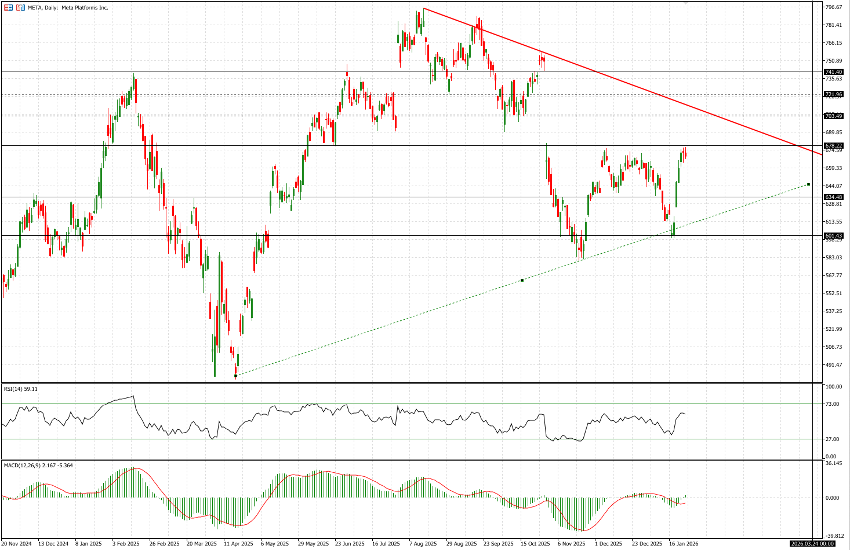
That concern was partially offset by robust operating momentum: ad impressions rose 18% year over year, while pricing increased 6%, providing sufficient earnings leverage to absorb higher investment. The decisive beat on both revenue and earnings triggered a ~10% surge in after-hours trading, reaffirming investor confidence in Meta’s execution. It is expected to open at $713.12, just at that red trendline.
Microsoft (MSFT)
Microsoft delivered 17% revenue growth, supported by cloud and AI demand, with operating income up 21% and operating margins at a strong 47%. However, gross margin edged down to 68%, reflecting the impact of elevated AI-related capital expenditure. Despite what was effectively a beat-and-raise quarter, the stock declined approximately 4% after hours.
Quarterly capex reached $37.5bn, implying an annualized run rate exceeding $150bn. The market response suggests growing concern that cloud margin compression could persist as infrastructure build-out accelerates. In essence, investors are increasingly questioning whether Microsoft is constructing an AI “cathedral” that may take longer to monetize than initially anticipated. During the quarter, the company returned $12.7bn to shareholders via buybacks and dividends.
Tesla (TSLA)
Tesla’s margins were a notable bright spot, with gross margin at 20.1% (automotive gross margin 17.9%), improving meaningfully on cost discipline and strong performance in energy storage, which delivered record revenue of $12.8bn, up 27% year over year. Nonetheless, Tesla reported its first-ever annual revenue decline, highlighting ongoing pressure in the core automotive business.
The earnings call was dominated by Elon Musk’s strategic pivot toward AI, robotics, and autonomy, including plans to repurpose Fremont factory lines previously used for Model S and X production to manufacture humanoid robots. In management’s framing, Tesla is no longer primarily an automotive company, but rather a platform for AI, robotics, and energy innovation. Despite continued weakness in vehicle demand, the stock rose approximately 2% in after-hours trading, reflecting investor willingness to focus on long-term optionality over near-term fundamentals.
