
Broadcom Riding the AI Boom

Today we step away from the conflict in the Middle East and return to equities, once again linked to AI. Over the past two days, Broadcom and Marvell Technology have reported their earnings (and by now 96% of the companies in the S&P 500 have done so). These two players are perhaps less well known but are dominant in the high-growth market for custom AI chips and data center networking. Think of them as the infrastructure that powers the AI revolution: while Nvidia makes the brains (GPUs), Broadcom and Marvell build the nervous system (networking) and the custom skeletons (ASICs) that hold everything together.
Broadcom is dominant in AI networking: modern AI clusters require ultra-high-speed interconnects to link thousands of accelerators. Broadcom’s Tomahawk 6 switch and Jericho 4 router are the de facto standards for hyperscale data center fabrics, with market share in cloud switching commonly estimated near 90%. The most strategic part of AVGO’s business (its ticker) is its custom accelerator—internally called XPU (Accelerated Processing Unit)—division. Dating back to 2014, when it co-designed the first Tensor Processing Unit with Google, Broadcom has built an unrivalled capability in co-developing application-specific integrated circuits (ASICs) tailored to each hyperscaler’s exact workload requirements. Together, these two segments place Broadcom at every critical node of the AI infrastructure stack. It is not an AI company in the traditional sense—it does not train models or build software applications—but it supplies the silicon that makes all of that possible.
The results were very strong: total revenue reached $19.31 billion (+29% YoY) and is expected to grow to $19.9 billion next quarter. $12.5 billion came from the semiconductor business (+53% YoY) and $6.8 billion from infrastructure software (which grew only 1% YoY). EPS beat expectations, coming in at $2.05 versus the $2.02 expected. The company generated $27 billion in free cash flow, and revenue from the AI segment now accounts for 44% of the total, compared with just 15% two years ago. Among its most important clients are OpenAI (ChatGPT), Anthropic (Claude), and Meta Platforms.
TECHNICAL ANALYSIS
The first thing that came to mind when looking at the chart was the similarity with Nvidia. After a very strong rally from the lows of last April to mid-July, the stock continued to rise until late autumn. However, six months later the levels at which it trades now ($337.07 yesterday, +4.87%) are not very far from those seen at the end of August (on 08/08 the close was $308). The similarity with Nvidia lies particularly in the floor, drawn in purple on the chart below—a dynamic level on which the price has continued to lean over the past few months. Someone with a bit of imagination and a desire to anticipate (something that is usually better avoided in trading) might even see the neckline of a potential Head and Shoulders pattern. Apart from this last observation, the main difference with Nvidia is that in this case the neckline is downward sloping, whereas for the “queen of AI” it is still pointing upward (although competing with the best always raises the bar).
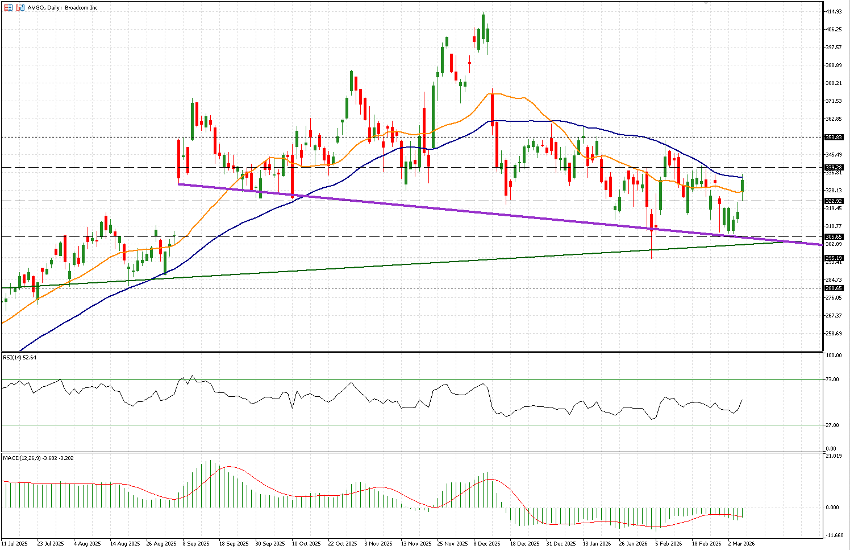
That said, the results were received positively. The price opened yesterday on the MA21 and pushed up to the MA50. It is therefore somewhat stuck in a sort of limbo for now and, moreover, the two moving averages have recently crossed to the downside.
The most important levels to monitor are the following: on the downside, $305, which coincides with the floor outlined on the chart and is also the level from which the strong gap up at the beginning of September started (when the $10 billion contract with OpenAI became public). On the upside, $339.30 will likely act as a tough resistance level that, if broken, could open the way toward $354. If $305 were to break to the downside instead, the first supports would be $295 and $280. Technically, however, such a move would represent a very negative signal that could push the stock significantly lower.