
EURJPY Falls After the BOJ

The Bank of Japan on Thursday kept its rates steady at 0.75%, as expected, but noted that inflation risks are now tilted to the upside due to the Iran war. The decision was split, with eight of the nine members voting in favour of a hold and only Hajime Takata proposing a rate hike to 1%.
Core inflation is expected to temporarily decelerate below 2% in the near term due to a slowdown in rice price increases, while the conflict in the Middle East will exert “upward pressure, affected by the recent rise in crude oil prices,” as Japan sources 95% of its energy imports from the region. Meanwhile, in January, headline CPI fell to 1.5%, dropping below the 2% threshold after 45 consecutive months.
2025 was a difficult year for wage growth, with wages declining every month. However, in January this year, real wages returned to growth, rising 1.4% year-on-year. This comes just before the spring wage negotiations, known as “shunto” talks, which involve Japan’s labour federations and the country’s largest firms. Notably, for the first time since 1989–1991, most corporations have already agreed to an average wage increase close to 5%.
Japan is therefore on a path of cautious normalization. Although Prime Minister Sanae Takaichi appears to oppose further increases in the policy rate—favouring regulatory measures such as controls on gasoline prices—most economists are now assessing whether the next tightening will occur in April or June, particularly following this week’s strong data on exports, imports, and machinery orders.
Meanwhile, the 10-year JGB surged this morning to 2.272%, its highest level since October 1998. It stood in negative territory (-0.22%) in the summer of 2019. The Nikkei is the worst-performing Asian equity index this morning, down 3.45%. The yen is broadly stable, strengthening only marginally against the USD (-0.06% at 159.77) and is now approaching the so-called “intervention zone”. It is slightly weaker against the EUR, up 0.04% at 183.16.
Technical Analysis
Technically, EURJPY is particularly interesting. Unlike USDJPY, it remains well above the previous highs set during 2024 (around 175.40, marked by the black line). However, unlike USDJPY, it is currently undergoing a consolidation phase, consistent with USD strength and EUR weakness.
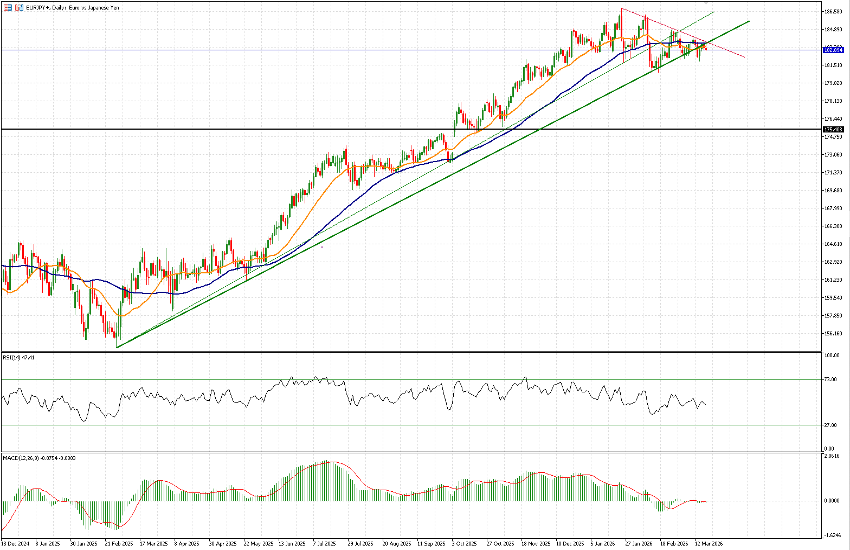
What stands out is that the uptrend appears to be losing momentum, and the trendline may be breaking. Two scenarios have been outlined (thin green and thick green), and even in the more extended case, the trendline appears to be tested from below this morning. RSI and MACD provide limited signals, remaining largely flat, while both the 21- and 50-day moving averages are now above price. This is a cross to monitor closely and, at this stage, not one we would consider for long positions.
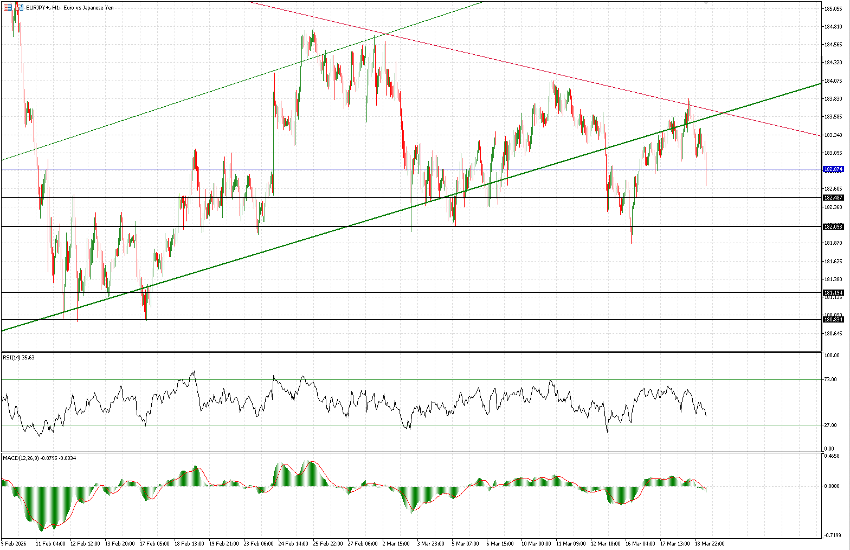
On the 30-minute chart, key downside levels to monitor include 182.50 and 180.80, with intermediate supports at 182.10 and 181.20.
