
EURUSD Struggles to Stabilize at 1.16

Since the beginning of the week, the USD has been strengthening significantly against all currencies, and the exchange rate with the euro is no exception. The rush to secure USD—potentially needed to meet upcoming financial obligations and part of the broader safe-haven demand—has pushed the USDX up by about 1.35% so far. Yesterday there was a slight pullback of 0.28%, coinciding with a rebound in U.S. equities.
EURUSD has followed a similar path. After breaking below the 1.1770 support level, which formed in early February and had been tested several times during the month, the pair fell sharply to a low of 1.1530 on Tuesday before attempting to stabilize around 1.16.
As is well known, the European bloc remains heavily dependent on energy imports. Specifically, around 12% of oil and 10% of gas are sourced from Persian Gulf countries and are therefore currently exposed to uncertainty or disruption. Higher energy costs are likely to negatively affect the trade balance, which is bearish for the euro. At the same time, the risk of slower economic growth due to more expensive production inputs could also weigh on the bloc’s economic outlook.
This combination of factors could potentially push the ECB to move away from its current wait-and-see stance, although it remains too early to draw firm conclusions. These issues are largely irrelevant for the United States, which is energy independent, helping to explain the recent weakness in EURUSD.
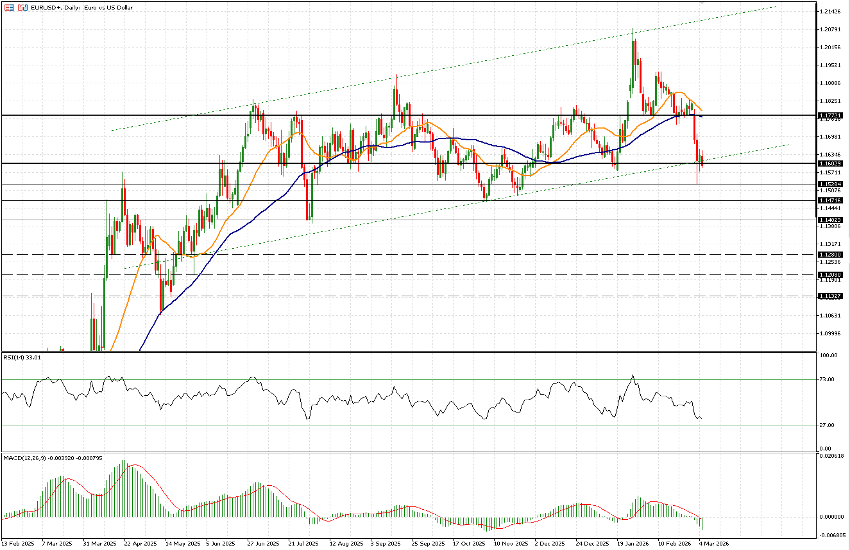
EURUSD Technical Outlook
While 1.1770 represented an important support level formed in February, the 1.16 area is considerably more pivotal. Prices have remained above this level since at least last June, and every downward move—such as those seen in late July and November—was quickly rejected and bought.
From a static perspective, 1.1530 represents the first relevant support, followed by 1.1470 and then 1.14. Below that level lies a broader accumulation zone corresponding to the price range where the pair traded last spring, roughly between 1.14 and 1.1280.
Further support can be found at 1.1210 and 1.1135, although reaching those levels would imply a move of roughly 5% from current prices, which is significant for a major currency pair.
For this reason, it appears more likely that the current decline could stabilize before reaching those deeper levels. Nevertheless, the medium-term direction may still point lower, although a battle between buyers and sellers is likely to continue around the current area.
Technical indicators remain clearly negative. The RSI stands at 33.5 and continues to trend lower, the MACD has turned negative, and price is trading well below both the 21-day and 50-day moving averages, which are also approaching a bearish crossover.
That said, the pair could see a temporary pause at current levels. Traders may therefore watch potential upside levels beginning at 1.1630, followed by 1.1650, and extending toward 1.1685.
