
META jumps on new AI release

Broad-based participation supported yesterday’s rally in the US market, with high-beta technology once again among the top performers (alongside Materials and Industrials). Both the Technology Select Sector SPDR Fund (XLK) (+3.10%) and the iShares Semiconductor ETF (SOXX) (+6.51%) led the move higher. Among big-cap names, Meta Platforms stood out as the best performer (+6.50%).
Yesterday, the company released MUSE SPARK, its latest model, which represents the output of an unusually compressed but capital-intensive development cycle: the system was built in roughly nine months by the newly formed Meta Superintelligence Labs following a sweeping reorganization and an estimated ~$14–15 billion commitment, including the acquisition of Scale AI and aggressive hiring of top-tier talent. This sits within a broader capex envelope where Meta is scaling AI infrastructure into the tens (and potentially hundreds) of billions, reflecting a strategic pivot to AI as its core growth driver. The prior generation, notably the LLaMA 4 series (2025), was widely perceived as underperforming on key benchmarks, prompting internal concern about Meta’s position in the AI race.
Muse Spark is concieved as a multimodal, agent-based system designed to be deeply embedded across Meta’s ecosystem (WhatsApp, Instagram, Facebook) and monetized via higher engagement, AI-assisted commerce, and task automation (e.g., shopping recommendations, visual analysis, health queries). Management’s thesis is that tighter vertical integration—linking AI directly to social graph data and advertiser surfaces—can both defend core ad revenues and open incremental monetization layers.
TECHNICAL ANALYSIS
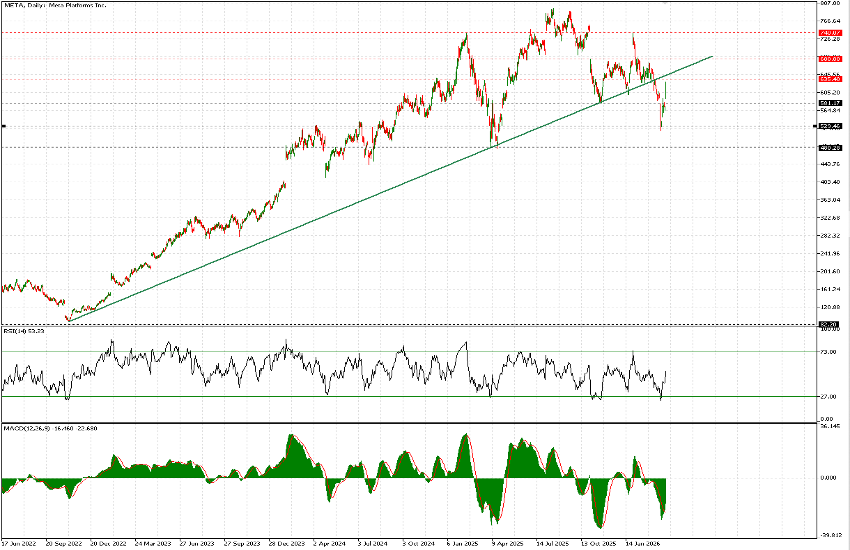
Yesterday’s rally technically represents an attempt to recover the strong uptrend that began in late summer 2022, which at one point delivered gains of 788%—an attempt that has not yet been fully successful. After declining 34.44% from the August 2025 highs to March 27, 2026, the stock began to rebound a few days ago near the $530 support level, one of the last major supports before another key level at $480. On the upside—and from a longer-term perspective—the key levels to monitor are $635, $680, and $740. The ascending trendline currently runs very close to the first of these resistance levels, and yesterday’s high ($629.27) approached that area; in essence, what appears to be forming is a retest from below of the previously broken uptrend.
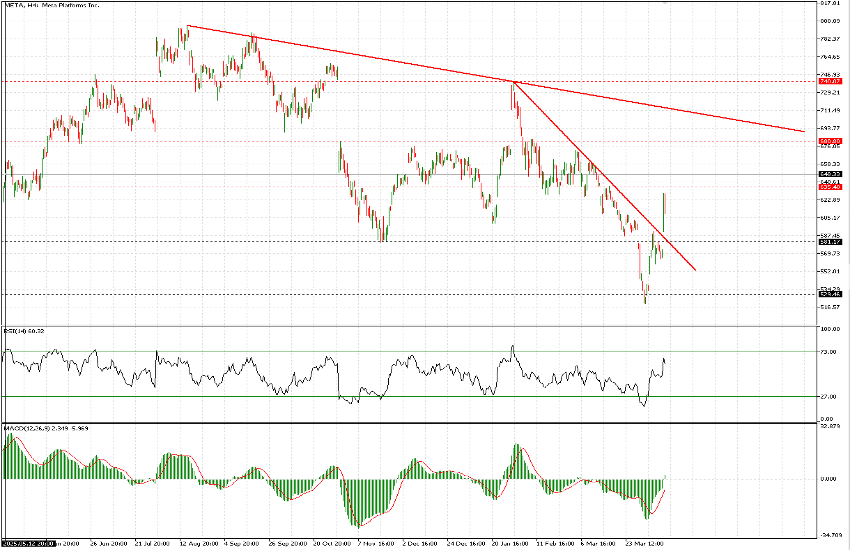
On a shorter timeframe, and in trying to define a clearer target for this newly initiated upward move, the outlook becomes slightly more constructive: the downtrend line from January appears to have been broken (a fairly bullish signal), and in the event of a clear move above the $635–$643 range, there could be further upside, likely toward the previously mentioned $680 resistance. At that point, the price would be approaching a more significant and less steep long-term downtrend line, warranting a reassessment. That said, much will depend on broader market performance and investor risk appetite in the coming weeks, given the evolving global backdrop.