
S&P 500 and Japan’s Hidden Market Influence

Yesterday we discussed the movements in the JPY, and as anticipated, today we will briefly cover their relevance for global risk markets and the global benchmark, the SP500
The Japanese banking and insurance sectors are among the largest and most important in the world. As of 2024, Japanese banks held approximately USD 17 trillion in total financial assets, with major players including MUFG Bank, Sumitomo Mitsui Banking Corporation, and Mizuho Bank. Japan’s insurance market is the second largest globally after the United States, with premium volumes of approximately USD 363 billion at the end of 2024. The sector holds over USD 2 trillion in assets and accounts for around 5% of global market share.
Japanese financial institutions play a critical role in global markets, particularly as one of the largest foreign holders of U.S. Treasury securities, with holdings totaling USD 1.138 trillion as of March 2025. Nippon Life Insurance Company was, in the past, the single largest holder of U.S. Treasury securities.
Japanese Government Bond (JGB) yields have become increasingly important for global markets. Japan’s 10-year JGB yield reached 2.09% in December 2025, the highest level since February 1999, while 30-year yields rose to 3.43%. More recently, 40-year JGB yields have breached 4.20%. As yields rise rapidly, Japanese investors are increasingly likely to repatriate capital from U.S. Treasuries (and other global markets) and invest domestically in JGBs due to higher local yields.
This I part of the well-known carry trade phenomenon. When Japanese interest rates remain low and the yen is weak or stable, investors borrow (sell) yen to fund investments in higher-yielding assets worldwide, pushing USD/JPY higher. However, when the yen strengthens rapidly, leveraged carry trade positions can unwind quickly, forcing investors to sell risk assets and buy back yen to close positions. The August 2024 carry trade unwind saw Japan’s Nikkei index crash by 12.4%, triggering a global selloff that pushed the S&P 500 down by 9.6%.
These interconnections are profound. Changes in the yen exchange rate—driven by JGB yields, interest rate differentials, and political intervention—play a central role in carry trades and in the flow of Japanese capital into U.S. and global markets, with the potential for cascading effects on asset prices worldwide.
THE CHART
What we are presenting here is not exactly a classic “technical analysis,” but rather a chart designed to visualize the relationship between USD/JPY and the US500, overlaid horizontally on MT5. It is clearly observable that downside moves in USD/JPY—triggered by interventions from the MoF (Ministry of Finance)—have been decisive and have generally either preceded or coincided with declines in the US500 (and, more broadly, in all global risk markets).
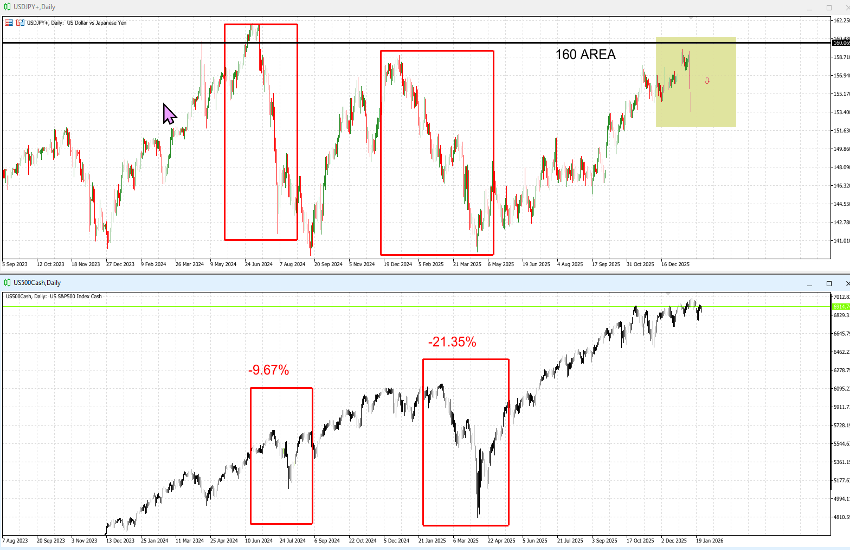
In 2024, a strengthening yen coincided with a 9.67% decline in the U.S. benchmark index; in early 2025, this drawdown reached 21.35% (in this case, the effects of announced tariffs also played a role, at least at the headline level). This is not always the case: the 2023 intervention saw markets continue to rise. However, current conditions are far more similar to the last two episodes (with USD/JPY levels closer to 160 than to 150), and the Japanese interest rate environment is even more challenging, with rates significantly higher.
Trading is an activity based on assessing probabilities rather than certainties; nevertheless, it is essential to observe details carefully—details that may seem insignificant, until they are no longer so.
