USD and Gold React to the Middle East Crisis
The impact on financial markets of the coordinated US–Israel attack on Iran, which is once again destabilizing the Middle East, is already becoming evident—and most likely we are only at the beginning.
Geographically, Iran occupies the entire northeastern coastline of the Persian Gulf and directly overlooks the Strait of Hormuz, through which approximately 25% of global oil supply transits daily. More than 80% of this volume is directed toward Asia, particularly China. At the same time, around 25% of global LNG shipments passed through this route in 2024, primarily originating from Qatar and largely destined for Europe.
It is therefore clear that the immediate economic repercussions primarily affect the broader Eurasian region. Further exacerbating concerns is the fact that this latest conflict does not appear likely to resolve quickly. Just hours ago, Donald Trump acknowledged that the war could last at least four weeks, while Iranian Security Chief Ali Larijani dismissed the possibility of talks with the United States. Meanwhile, attacks on US bases in the region are intensifying, with the first confirmed American military casualties reported and at least nine countries’ territories targeted by Iranian retaliation.
Markets opened under pressure: US equity futures were down approximately 1%, while oil initially surged by 8% before partially retracing, though it remains up roughly 6.5% at the time of writing. DAX futures in Europe are under greater strain, currently down 1.3%. In Asia, where the cash session is well underway, major indices are trading between -1.5% and -2%. Airlines are particularly weak—flight disruptions have not reached these levels since the COVID period—while, for now, energy companies are among the few beneficiaries.
The US dollar is benefiting from its safe-haven status (USDX +0.47%), supported by the trillions of dollars in global contracts—both derivative and non-derivative—denominated in USD and the necessity of holding dollar liquidity to service them. Gold has also attracted strong bids; despite the downside volatility seen in recent weeks, it is currently trading up 1.87%, approximately $40 below its all-time closing high.
TECHNICAL ANALYSIS
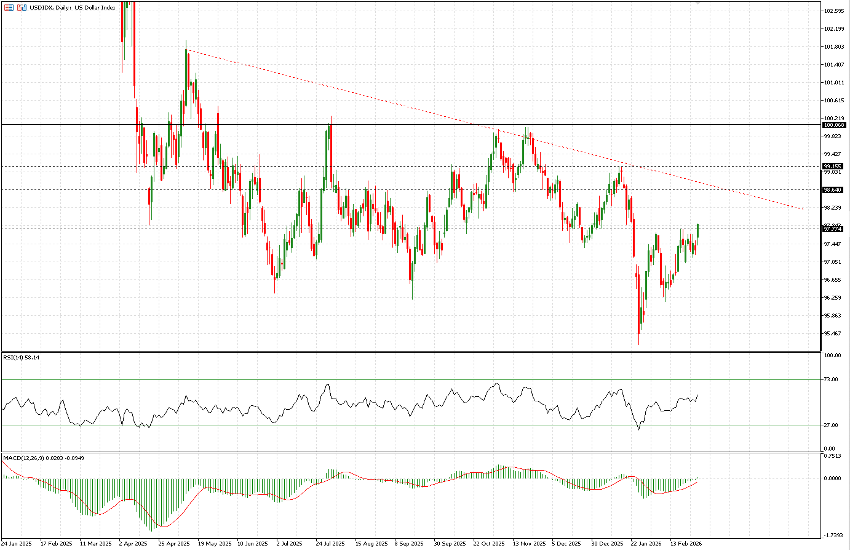
The USDIDX has broken above its previous relative high and the consolidation zone of the past seven sessions in the 97.65–97.75 area and is currently trading at 97.88. This breakout, together with the RSI (57.98, trending upward) and the MACD (histogram turning positive today), suggests that the upward move is likely to continue.
The natural targets are the resistance levels at 98.65 and 99.15. Between these two levels, there is also a minor descending trendline (shown as a red dashed line), which we note purely for completeness. Above these levels lies the more significant resistance at 100.05; however, the index remains approximately 2.2% below that threshold.
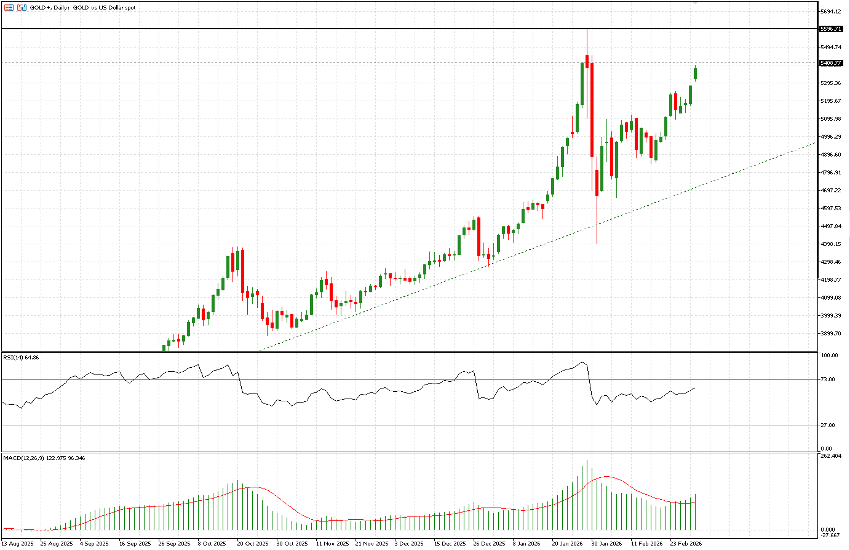
Gold, for its part, has quickly recovered the losses recorded exactly one month ago, when it briefly tested $4,400 before consolidating in the $4,850–$5,050 range. It also experienced several additional days of consolidation last week, as it was unable—until Friday (unlike the USD)—to break above the $5,230 area. It is now trading up 1.82% at $5,376.
The highest closing price ever recorded on our platform was $5,408, and it appears likely that this level will be retested in the near term. The absolute high was marked at $5,598 on Wednesday, January 28—and should tensions persist, as currently seems probable, it cannot be ruled out that sovereign states may seek to hedge geopolitical risk through exposure to the precious metal, diversifying—albeit only partially—away from the USD.
Note: In this section, we have deliberately avoided referencing the geopolitical backdrop and have confined our analysis strictly to price levels and technical indicators. Traders who rely on technical analysis should primarily anchor their decisions to these tools, even in a challenging and emotionally charged geopolitical environment, as they represent the only structured framework capable of mitigating sudden and potentially significant market moves in the current context.