
USDCHF: Swiss SNB Shifts Focus to FX Intervention

At its March 19, 2026 monetary policy meeting, the Swiss National Bank (SNB) left the official rate unchanged at 0.00%, maintaining its ultra-low-rate stance amid subdued inflation and a still-elevated Swiss franc. The Bank reiterated that sight deposits at the SNB would continue to be remunerated at the policy rate up to a certain threshold, with a 0.25 percentage-point discount applied to balances above that level, reinforcing the current accommodative money-market framework.
While the rate decision itself was largely in line with market expectations, the Governing Board’s guidance shifted the focus toward the FX front. The SNB explicitly stated that its willingness to intervene in the foreign-exchange market has increased, particularly in light of ongoing geopolitical tensions in the Middle East and the associated risk of a rapid and excessive appreciation of the Swiss franc. Chairman Schlegel has underscored that the bar for reintroducing a negative policy rate remains high, leading markets to interpret FX intervention—the purchase of foreign currencies and sale of francs—as the SNB’s preferred tool to cap CHF strength in the near term.
The Swiss franc’s recent strength reflects a combination of structural and cyclical factors. The Swiss economy continues to run a large current-account surplus, often above 5% of GDP, generating persistent demand for franc-denominated assets. At the same time, Switzerland’s exceptionally low inflation—around 0.1% in 2026—supports the franc’s role as a store of value, particularly relative to higher-inflation economies such as the U.S. and the euro area.
Geopolitical and macro uncertainty—including Middle East tensions, trade-policy risks, and elevated global volatility—has reinforced the franc’s safe-haven status. Capital flows into Swiss bonds, equity ETFs, and private banking deposits have added further upward pressure on the currency, even as the SNB maintains a zero-rate policy and modest growth outlook.
From a market perspective, the SNB’s increased readiness to intervene implies that one-way CHF-long positioning carries elevated central-bank risk, particularly if the currency approaches key technical or psychological levels. With inflation projected around 0.5% for 2026–2028 and policy rates already at zero, the SNB’s ability to respond through conventional tools remains limited, increasing reliance on direct FX intervention.
Investors should therefore treat the Swiss franc as a structurally strong, low-yield safe-haven currency, while closely monitoring SNB communication for signals of potential intervention.
Technical Analysis
USD/CHF began to move higher after reaching a low of 0.7604 on January 27. The 0.77 and 0.7830 levels remain significant, dating back to July–August 2011, just before the SNB introduced the currency floor during the sovereign debt crisis. These levels can be viewed as historical intervention zones.
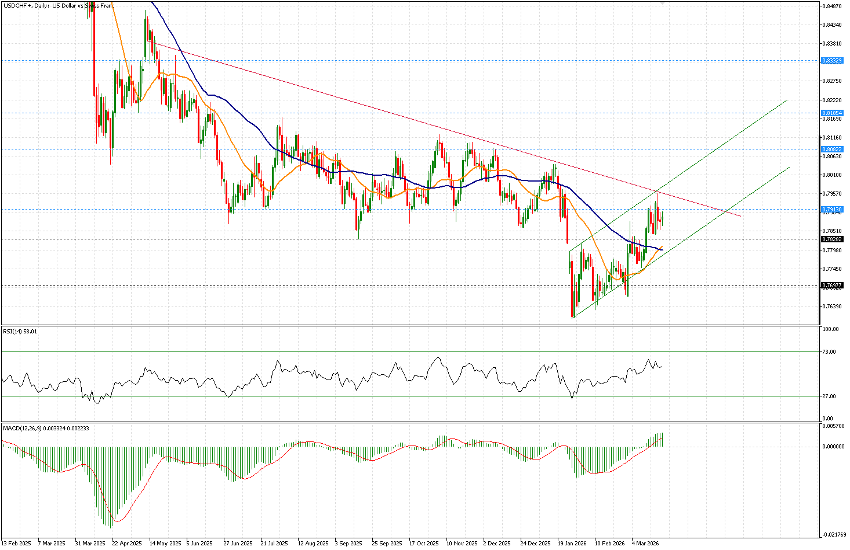
In recent weeks, the pair traded within this range before breaking higher ahead of last week and moving toward resistance around 0.7915, which is currently being tested. The broader trend remains bearish, as indicated by the descending trendline in place since April 2025, although a longer-term resistance trendline sits closer to 0.87.
In the near term, USD/CHF is advancing within a defined upward channel. The pair is trading above both the 21-day and 50-day moving averages, which have recently crossed to the upside. The RSI stands at 58.33, while the MACD remains in positive territory.
There is scope for a further move toward 0.7950, with initial resistance at 0.7915. A break higher could open the way toward 0.7985 and subsequently 0.8085. In this scenario, additional upside may develop over the medium term.
Overall, while the Swiss franc remains structurally strong, increasing central-bank sensitivity to currency appreciation suggests that traders should be cautious when positioning against potential SNB intervention.
